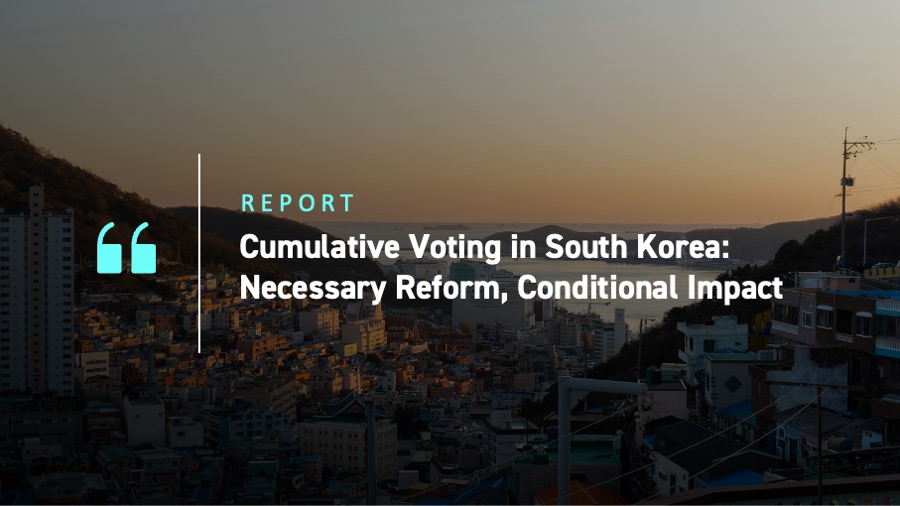
Below is an excerpt from ISS’ recently released report titled Cumulative Voting in South Korea: Necessary Reform, Conditional Impact. The full report is available to institutional subscribers by logging into ProxyExchange then selecting the Knowledge Center and its Library tab and to corporate subscribers by logging into Compass then selecting Governance and the Governance Library or Governance Exchange tab.
If you are not a subscriber, you can download a copy of the full report here.
Ahead of South Korea’s 2026 annual shareholder meeting season, cumulative voting is once again a focal point in the debate surrounding corporate governance in Asia’s fourth largest economy. The cumulative voting mechanism has become one of the most frequently raised topics in institutional investor engagement, routinely framed as a decisive reform—one that will strengthen minority shareholder rights, improve board accountability, and ultimately help narrow the persistent “Korea discount.” This expectation, while understandable, places disproportionate weight on a single governance mechanism and fails to account for other structural impediments that constrain its use and effectiveness.
Based on extensive analysis of ISS agenda taxonomy, voting outcomes, and issuer and investor engagement, this report finds cumulative voting not as a panacea, but as a conditional safeguard. Whether it meaningfully alters governance outcomes depends less on its legal availability than on the architecture of the board and the structure of director elections. In practice, board size, seat availability, election sequencing, and term structure determine whether cumulative voting can function as a genuine accountability mechanism—or remain largely symbolic. As a result, the central governance question this report seeks to answer is not simply whether cumulative voting exists, but whether the structures surrounding it allow it to function effectively.
- If you are not a subscriber, please contact sales@iss-stoxx.com (for institutional investors) or contactus@isscorporatesolutions.com (for corporations) to learn more about accessing bespoke governance research.
By: Glenn Maguire, AhRum Choi, Chungju Kim, Shin Hong Kim